Αρχειοθήκη ιστολογίου

Αναζήτηση αυτού του ιστολογίου

Δευτέρα 18 Ιουλίου 2022

Long-term exposure to low-level air pollution, genetic susceptibility and risk of dementia

alexandrossfakianakis shared this article with you from Inoreader

m_dyac146f1.jpeg?Expires=1721224181&Sign

Abstract
BackgroundWe aimed to assess the association between low-level air pollution and the risk of dementia, and examine the modification effect by genetic susceptibility on the relationship.
Methods
A total of 164 447 participants who were free of dementia at baseline and aged ≥60 years were included. Annual average concentrations of particulate matter (PM) with diameters of ≤2.5 μm (PM2.5), between 2.5 and 10 μm (PMcoarse), PM2.5 absorbance and nitrogen dioxides (NO2) were evaluated using the Land Use Regression models. Cox proportional hazards regression was used to estimate the association between air pollutants and incident dementia.
Results
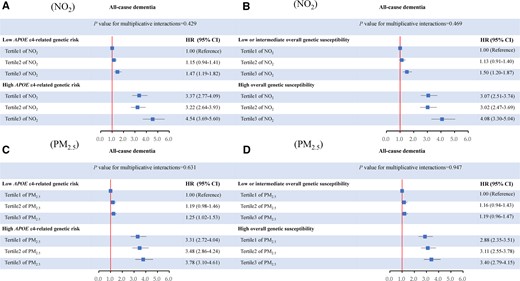
The adjusted hazard ratio (HR) of dementia for a 5-μg/m3 increase in NO2 was 1.09 (95% CI, 1.05–1.14); the adjusted HR of dementia for a 1-μg/m3 increase in PM2.5 was 1.10 (1.04–1.17). Such significant associations were present even within concentration ranges well below the present World Health Organization, US and European annual mean limit values. In addition, higher PM2.5 absorbance, a marker closely related to motorized traffic, was associated with higher risk of dementia. We found the risk of dementia associated with a combination of air pollutants (NO2 or PM2.5) and high genetic susceptibility (APOE-ε4 alleles or overall genetic susceptibility) was greater than the addition of the risk associated with each individual factor, indicating significant interactions on an additive scale (all P-interaction < 0.05).
Conclusion
Long-term exposure to PM2.5 or NO2, even at relatively low levels, is associated with a higher risk of dementia. Air pollution may additively interact with the genetic susceptibility on dementia risk.
View on Web

Gestational Weight Gain and Birth Outcomes: A Comparison of Methods to Account for Gestational Age

alexandrossfakianakis shared this article with you from Inoreader

aje_ogimage.png

Abstract
Cross-sectional studies of total gestational weight gain (GWG) and perinatal outcomes have used different approaches to operationalize GWG and adjust for gestational duration. Using birth records from California (2007-2017), Nevada (2010-2017), and Oregon (2008-2017) we compared three commonly used approaches to estimate associations between GWG and cesarean delivery (C-section), small for gestational age (SGA), and low birth weight (LBW)]: (1) the Institute of Medicine r ecommended GWG ranges at a given gestational week, (2) total weight gain categories directly adjusting for gestational age as a covariate, and (3) weight-gain-for-gestational-age z-scores derived from an external longitudinal reference population. Among 5,461,130 births, the three methods yielded similar conclusions for C-section and SGA. However, for LBW, some associations based on z-scores were in the opposite direction of methods 1 and 2, paradoxically suggesting higher GWG increases risk of LBW. This was due to a greater proportion of preterm births among those with high z-scores, and controlling for gestational age in the z-score model brought the results in line with the other methods. We conclude that the use of externally-derived GWG z-scores based on ongoing pregnancies can yield associations confounded by duration of pregnancy when the outcome is strongly associated with gestational age at delivery.
View on Web

Κυριακή 17 Ιουλίου 2022

Nutrition Education: Optimizing Preparation and Recovery for Benign Esophageal Surgery

alexandrossfakianakis shared this article with you from Inoreader

Abstract

Background

Patients requiring upper gastrointestinal surgery for benign esophageal conditions are at nutrition risk before and after surgery. There is a dearth of published evidence guiding clinicians on effective collaboration with patients to mitigate perioperative nutritional challenges. We conducted a qualitative study to explore patients' perioperative food, nutrition, and educational experiences to guide future care.

Methods

Adult patients who had undergone elective, benign esophageal surgery were invited to participate in semi-structured interviews within 3 weeks of hospital discharge. Interviews were transcribed and analyzed with a reflexive form of inductive thematic analysis in addition to synthesized member checking.

Results

Interviews with 12 patients identified three major themes. First, nutrition education fosters a better surgical recovery experience: patients expressed a desire to be prepared for their upcoming surgery a nd engage in the recovery process with informed food choices. Most patients preferred preoperative education given limited capacity for learning during hospital admission. Second, patients have priorities for nutrition information: patients expressed that educational material should be printed, comprehensive, practical, include familiar foods, and focus on managing postoperative physical symptoms. Third, food impacts social and emotional experiences of surgery: resumption of a normal diet was a sign of recovery that enabled social reintegration. Identified themes resonated with Knowles' six-core principles of andragogy.

Conclusions

Patients with benign esophageal conditions perceived nutrition education to be a vital aspect of surgical preparation and recovery. Re-designing perioperative education with patient input has the potential to improve outcomes and experiences.

This article is protected by copyright. All rights reserved.

View on Web

Latent class analysis to characterize neonatal risk for neurodevelopmental differences

alexandrossfakianakis shared this article with you from Inoreader

Background

Neonatal risk factors, such as preterm birth and low birth weight, have been robustly linked to neurodevelopmental deficits, yet it is still unclear why some infants born preterm and/or low birth weight experience neurodevelopmental difficulties while others do not. The current study investigated this heterogeneity in neurodevelopmental abilities by examining additional neonatal morbidities as risk factors, utilizing latent class analysis to classify neonates into groups based on similar neonatal risk factors, and including neonates from the full spectrum of gestational age.

Methods

Neonates who received neonatal care at an academic public hospital during an almost 10-year period (n = 19,951) were included in the latent class analysis, and 21 neonatal indicators of health were used. Neonatal class, sex, and the interaction between neonatal class and sex were used to examine differences in neurodevelopment at 18 months of age in a typically developing population.

Results

The best fitting model included five infant classes: healthy, hypoxic, critically ill, minorly ill, and complicated delivery. Scores on the parent-rated neurodevelopmental measure differed by class such that infants in the critically ill, minorly ill, and complicated delivery classes had lower scores. There was no main effect of sex on the neurodevelopmental measure scores, but the interaction between sex and neonatal class was significant for three out of five neurodevelopmental domains.

Conclusions

The current study extends the understanding of risk factors in neurodevelopment by including several neonatal medical conditions that are often overlooked and by using a person-centered, as opposed to variable-centered, approach. Future work should continue to examine risk factors, such as maternal health during pregnancy and medical interventions for newborns, in relation to neonatal risks and neurodevelopment by using a person-centered approach.

View on Web

Empagliflozin has favourable effect on frontal plane QRS‐T angle in diabetic patients with cardiovascular disease

alexandrossfakianakis shared this article with you from Inoreader
Empagliflozin has favourable effect on frontal plane QRS-T angle in diabetic patients with cardiovascular disease

Empagliflozin treatment is associated with a significant decrease in the frontal plane QRS-T angle (fQRST) in patients with diabetes mellitus (DM). However, despite similar antihyperglycemic effect with empagliflozin treatment in patients with and without cardiovascular disease (CVD), the significant decrease in fQRST angle was observed only in patients with CVD and no significant decrease was observed in fQRST angle in patients without CVD. Therefore, as a sign of ventricular repolarization heterogeneity that can be easily measured from a standard 12-lead electrocardiography (ECG), fQRST angle may be a useful ECG parameter in the monitoring of cardiovascular effects of empagliflozin in type 2 DM patients with CVD.


Abstract

What is Known and Objective

Empagliflozin treatment is significantly associated with lower risk of cardiovascular events in patients with diabetes mellitus (DM) independent of its antihyperglycemic effect. However, little is known regarding the impact of empagliflozin on electrocardiography (ECG) parameters. This study aimed to investigate whether empagliflozin has favourable effect on frontal plane QRS-T (fQRST) angle, which is an ECG sign of ventricular repolarization heterogeneity, in patients with type 2 DM.

Methods

We prospectively enrolled 111 patients with known diagnosis of type 2 DM who newly prescribed empagliflozin on top of their standard anti-diabetic therapy. Patients were divided into two groups according to presence or absence of cardiovascular disease (CVD) at baseline and followed-up for 6 months. The impact of empagliflozin treatment on fQRST angle was investigated and patient groups were compared regarding the pre- and post-treatment fQRST angle.

Results and Discussion

Among 111 patients, 32 (28.8%) had CVD and 79 (71.2%) had no CVD. Empagliflozin treatment lead a significant decrease in the mean fQRST angle throughout the study period and mean fQRST angle was significantly lower at 3- and 6-month follow-up visits compared to baseline values (62° ± 17.4° vs. 57.2° ± 14.8° vs. 50.5° ± 13.6°, p < 0.001 for all dual comparisons). However, despite similar antihyperglycemic effect with empagliflozin treatment in patients with and without CVD, the significant decrease in the mean fQRST angle was observed only in patients with CVD and no significant decrease was observed in the mean fQRST angle in patients without CVD.

What is New and Conclusion

Empagliflozin leads a significant narrowing in the fQRST angle in type 2 DM patients with known CVD.

View on Web

Πέμπτη 14 Ιουλίου 2022

“Inhaled Zanamivir versus Oral Oseltamivir to Prevent Influenza-related Hospitalization or Death: A Nationwide Population-based Quasi-experimental Study”

alexandrossfakianakis shared this article with you from Inoreader
to the editor—In their recent article, Su et al compared the effectiveness of inhaled zanamivir and oral oseltamivir for influenza patients in a quasi-experimental cohort study using population-based National Health Insurance Research Database [1]. They found that prescribing zanamivir for clinically diagnosed influenza patients within 48 hours was not inferior to oseltamivir in terms of the risk of subsequent influenza-related hospitalization and death. In addition to the limitations mentioned by the authors, we would like to share some ideas regarding the study design as well as further investigations that would be of interest to the readers.
View on Web

Postoperative Gabapentin's Effect on Opioid Consumption and Pain Control Following Sinonasal Surgery

alexandrossfakianakis shared this article with you from Inoreader

Objective

This study investigates the impact of postoperative gabapentin on opioid consumption and pain control following endoscopic sinus surgery (ESS) and/or septoplasty.

Methods

Patients who underwent ESS and/or septoplasty at a single institution from 2021 to 2022 were enrolled. All patients received postoperative hydrocodone-acetaminophen for pain control. Half of the patients were also prescribed gabapentin for the first postoperative day in addition to hydrocodone-acetaminophen. Subjects completed the Revised American Pain Society Patient Outcome Questionnaire 24 h and 7 days after surgery. We conducted a multivariable regression analysis to assess opioid consumption and improvement in pain scores in the first week between gabapentin and non-gabapentin groups.

Results

A total of 102 subjects, 51 in each arm, were enrolled. The mean age was 52 years and 53% of participants were female. Controlling for important baseline demographic, clinical, and surgically related variables, the addition of postoperative gabapentin was associated with a 44% (9.5 mg from 21.6 mg) reduction in opioids consumed in the first postoperative week (B = −9.54, 95% C.I. = [−17.84, −1.24], p = 0.025). In addition, patients in both arms exhibited similar improvement in pain severity and sleep interference in the first 7 days (B = −1.59, 95% C.I. = [−5.03, 1.84], p = 0.36).

Conclusion

To the best of our knowledge, this is the first study to investigate the impact of postoperative gabapentin on opioid consumption and pain control following ESS and/or septoplasty. Our analysis demonstrated that postoperative gabapentin effectively reduced opioid use during the first postoperative week without compromising pain control.

Level of Evidence

3 Laryngoscope, 2022

View on Web